Durham Early Educator Apprenticeships
Your path to better pay and a free degree
How can an apprenticeship support me in my early childhood career?

Who can participate?
- Current early childhood educators: Earn a Certificate or Associate Degree in Early Childhood Education while working
- New/Aspiring early educators: Professionals new to the early childhood field can earn certificates and degrees while working
- Current high school students: Earn high school and college credit, and participate in work-based learning
- Experienced educators with higher degrees: Receive stipends to serve as a mentor for apprentices
What apprenticeship opportunities are available in Durham?
Who can participate? Current high school students age 16+
Program Components:
Coursework: Pre-apprentices enroll in early childhood coursework through their high school’s Career and Technical Education (CTE) program by taking FE11, or enroll in EDU 119 at Durham Tech through the Career and College Promise (CCP) program. Tuition is free for the college course at Durham Tech, and textbooks are covered by the Pre-Apprenticeship program.
Work-based learning: Complete work-based learning in a high-quality child care setting, with opportunities to learn from experienced early childhood educators, build professional connections for future employment in the field, and build work-based experience on your resume.
Stipends and support: Pre-apprentices receive stipends for performance, transportation, and completion in order to provide financial support for successful participation in work-based learning. Pre-apprentices also receive free basic certifications that are immediately transferable to the early childhood field, free professional development, and career development opportunities.
What are the benefits of participating in a pre-apprenticeship?
- Receive US Department of Labor Certificate upon completion
- Receive NC Early Childhood Credential upon completion
- Free tuition and textbooks for related instruction at community college
- Eligible for tuition waivers for early childhood degree tracks in community college after graduating high school, leading to a tuition-free Associate Degree
Who can participate? Individuals age 18+ with a High School Diploma/ Equivalent. Must either already be working 30+ hours per week in licensed child care setting, or able to be hired 30+ hours per week by licensed child care provider.
Program Components:
Learn: Apprentices learn through a combination of structured on-the-job learning and college coursework.
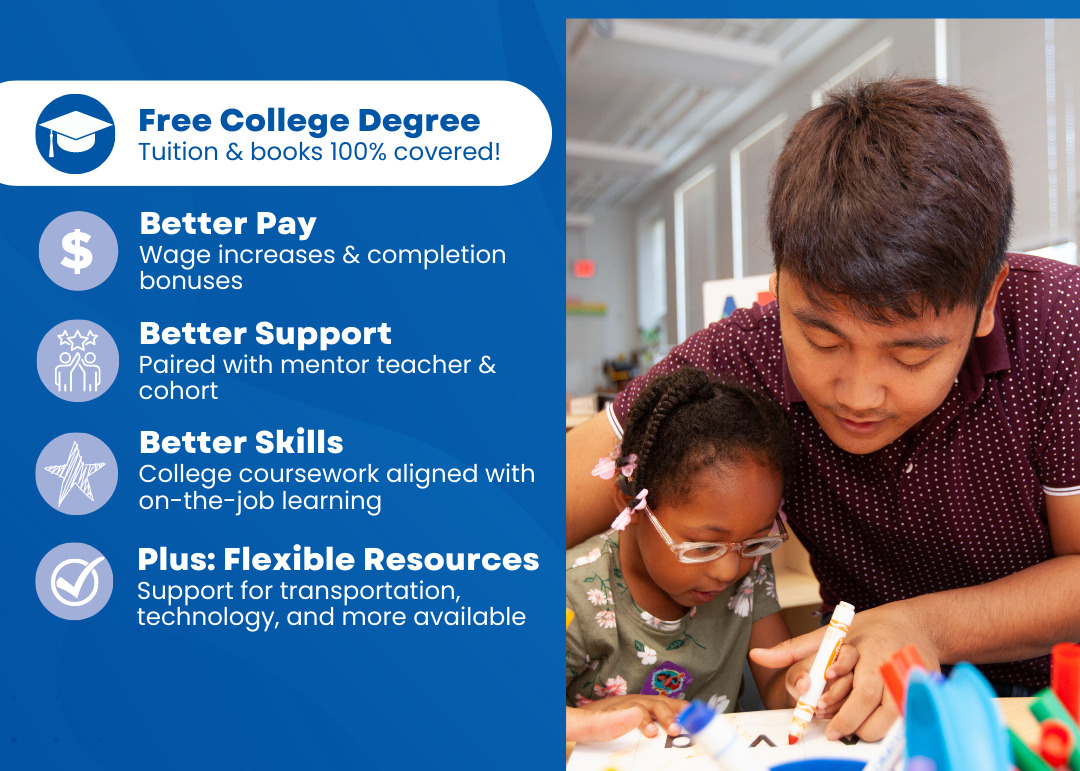
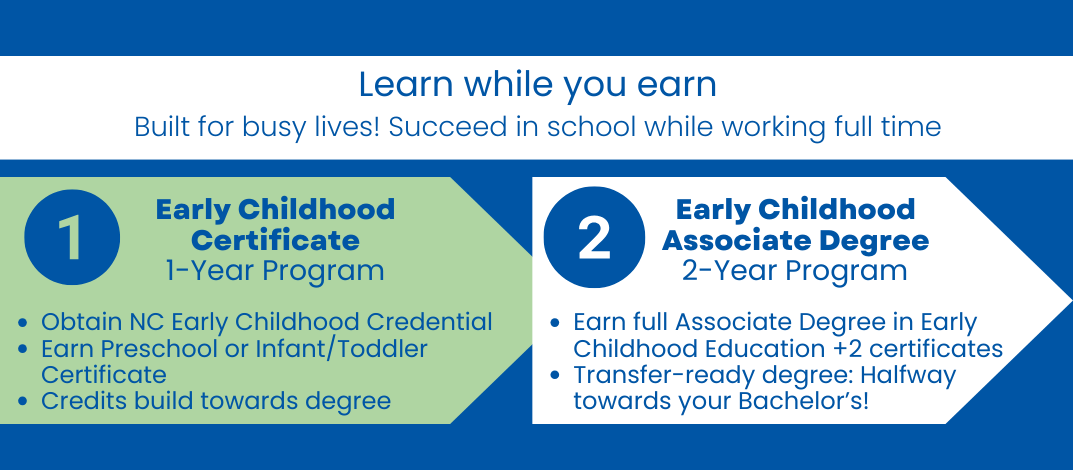
- Receive a full scholarship, with tuition and textbooks 100% covered by the T.E.A.C.H. Early Childhood® Scholarship to complete a Certificate in Early Childhood Education – either the Infant/Toddler Certificate or Preschool Certificate.
- Earn the NC Early Childhood Credential: The first course in the Certificate is EDU 119: Intro to Early Childhood Education. By passing this course with a grade of C or higher, apprentices fulfill the requirements for the NC Early Childhood Credential from the NC Division of Child Development and Early Education.
- Take college classes built for working adults: Apprentices enroll in a minimum of 1 class per semester, with all early childhood courses available in a fully online and flexible format (with bilingual course options available).
- Get the time you need to succeed: Receive 3 hours per week of paid release time during each academic semester to complete coursework and/or meet with your mentor teacher.
- Get on the fast track to credentials: Courses are 8 weeks long. Apprentices can complete the Certificate in as little as 2 semesters, but most apprentices working full-time while managing other responsibilities opt to take 1 class at a time, and can still complete the certificate in 3 semesters (or 1 year).
- Learn while you earn: Mentor teacher helps you build practical skills on-the-job.
Earn:
- Earn increased wages from your employer as you achieve milestones.
- Earn completion bonuses for completing academic coursework.
- Maximize your financial aid by applying for FAFSA/Financial Aid to supplement scholarships.
Achieve:
- Earn US Department of Labor Certificate upon completion
- Earn Infant/Toddler Certificate or Preschool Certificate (and college credits which can built towards an Associate Degree and transfer towards a Bachelor’s Degree)
- Higher wages for higher-level work
- Greater opportunities for advancement through continued employment growth in the early childhood field
Who can participate? Individuals age 18+ with a High School Diploma/ Equivalent. Must either already be working 30+ hours per week in licensed child care setting, or able to be hired 30+ hours per week by licensed child care provider
Program Components:
Learn: Apprentices learn through a combination of structured on-the-job learning and college coursework.
- Receive a full scholarship, with tuition and textbooks 100% covered by the T.E.A.C.H. Early Childhood® Scholarship to complete your Associate in Applied Sciences in Early Childhood Education.
- Take college classes built for working adults: Apprentices enroll in a minimum of 1 class per semester, with all early childhood courses available in a fully online and flexible format (with bilingual course options available). Courses are 8 weeks long, so most apprentices are able to take 1 class at a time, but still complete 2 classes every semester.
- Get the time you need to succeed: Receive 3 hours per week of paid release time during each academic semester to complete coursework and/or meet with your mentor teacher.
- Learn while you earn: Mentor teacher helps you build practical skills on-the-job.
Earn:
- Earn increased wages from your employer as you achieve milestones.
- Earn completion bonuses for completing academic coursework.
- Maximize your financial aid by applying for FAFSA/Financial Aid to supplement scholarships.
Plus: Flexible Resources:
- Receive support connecting with resources for transportation, internet, child care, or other needs to support your success.
- Receive a computer for online coursework, if needed.
Achieve:
- Earn US Department of Labor Certificate upon completion
- Earn college credits/college degree which can transfer towards a Bachelor’s Degree
- Higher wages for higher-level work
- Greater opportunities for advancement through continued employment growth in the early childhood field
- For individuals 18+ with an Associate Degree or higher in early childhood education or related fields, interested in pursuing a Bachelor’s in early childhood education
- If you’re interested in this option, go ahead and connect with us as details are coming soon!
- Click here to watch the Early Childhood Education Bachelor's Degree Info Session.
Learn more about apprenticeship opportunities:
- View a recording of our Apprenticeship Info Session
- View a list of our Apprenticeship locations
- View a recording of our session: Scholarships and Financial Aid for Early Educators
Complete this interest form and our team will follow up with you about next steps to connect with partnering programs based on your interests and goals!
Information for Employers:
How can apprenticeships support my program/business and my workforce?
- Improved pathways for teacher recruitment, retention, and professional development
- Full scholarships for staff to enhance skills, increase education, and earn credentials
- Increased opportunities for staff for advancement and leadership development
- Reimbursed for paid release time by T.E.A.C.H. Early Childhood®
- Stipends and free professional development for mentors
- Free professional development opportunities for partnering apprentices, mentors, and directors
What are my options as an employer to participate in a registered apprenticeship program?
- Become a Partnering Employer with Early Years Registered Apprenticeship Programs: Early Years acts as a sponsoring organization for Registered Apprenticeship Programs in early childhood education in Durham, and employers may choose to partner with this registered apprenticeship program in order to support apprenticeships at your site(s). As the sponsor, Early Years' goal is to reduce the need for partnering child care centers to take on too much additional paperwork, and to standardize some elements of program design so that we can collectively recruit for and promote the program to prospective apprentices, mentors, and centers. For partnering employers, Early Years manages paperwork associated with registering each apprentice and documenting their progress towards completion. Contact: Maggie West, maggiew@earlyyearsnc.org
- Sponsor your own Registered Apprenticeship Program through ApprenticeshipNC: Centers can also choose to sponsor your own Registered Apprenticeship Program, building a program to specifically meet your needs and capacity and maintaining apprenticeship documentation in-house. Contact the ApprenticeshipNC consultant for the Durham area to get started: Tony McKnight, mcknightt@
nccommunitycolleges.edu - Centers can also choose to host Pre-Apprentice (Current high school students participating in a registered pre-apprenticeship program). Pre-Apprentices may be paid or unpaid, depending on the center, and have fewer work-based learning hours required than apprentices. Pre-Apprentices can be an excellent method to grow your own talent and workforce if you have current high school students in your community who would be interested in free community college courses, and tuition waivers to complete their Associate Degree in early childhood education. Contact the Apprenticeship Coordinator at Durham Technical Community College to learn more: Dr. Norman Collins, collinsn@durhamtech.edu
Apply to become a partnering employer and our team will follow up with you about next steps.
Information for Interested Mentors:
The apprenticeship program is currently recruiting experienced early childhood educators to serve as mentors for apprentices. Details of the expectations, qualifications, and compensation for mentors is included below and in this Mentor Role Description.
The mentor-apprentice relationship is the foundation for a successful apprenticeship program, as the mentor plays a crucial role in facilitating meaningful on-the-job learning, reflection, and professional growth with the apprentice. A positive mentoring relationship also increases the likelihood that an apprentice will feel supported, listened to, and cared for in the midst of a very demanding profession - hopefully supporting greater longevity and growth in the early childhood field. Goals include:
- Promote reflective practice and professional growth of early childhood apprentices by pairing apprentices with experienced, high-quality educators willing to share their expertise
- Promote leadership skills and career development opportunities of early childhood mentors by providing meaningful training and professional support to mentors
Based on the scope of the apprenticeship program in the pilot year, Early Years will be supporting apprentices and mentors using two models, depending on the needs and capacity of the partnering employers:
- On-site mentors are qualified staff working at the apprentice(s)’s place of employment who are interested in serving as mentors and recommended by their Director for this role.
- Cohort mentors are experienced educators working in a different center than the apprentice(s) with whom they are assigned as mentors. When a qualified mentor is not available at the apprentice’s place of employment, a cohort mentor will be engaged to provide professional mentorship to the apprentice, in coordination with on-site supervisory feedback.
- Promote reflective practice, professional growth, and on-the-job learning with early childhood apprentice(s) as either a:
- On-Site Mentor through modeling, observation, clear objectives, reflective conversations, constructive feedback, and regular review of/completion of an On-the-Job learning checklist with apprentice.
- Cohort Mentor through goal-setting, clear objectives, reflective conversations, constructive feedback, and regular review of an On-the-Job learning checklist completed by on-site supervisor.
- Build a supportive, growth-oriented relationship with apprentice(s) by providing ongoing communication and support. Mentors are expected to meet at least once per week with apprentice(s) to check in, review progress/questions, and offer guidance/support. For mentors serving apprentices at multiple sites, expectation is to meet at least 2 times per month in person, and to connect by phone/virtually in alternate weeks.
- Ensure apprentice(s) have the support and resources they need to succeed by lifting up any concerns, challenges, or barriers they may be experiencing to program staff to request additional support
- Attend required initial on-boarding for mentors and participate in virtual monthly Communities of Practice sessions to share resources and discuss best practices
- Complete mentoring log and submit to Early Years monthly
- Communicate with Early Years about any issues or concerns
- Uphold confidentiality agreements and respect the privacy of apprentice(s)
- At least a Bachelor’s degree in child development, early childhood education, or related field (according to DCDEE guidelines), and/or Birth-Kindergarten Licensure
- At least 3 years of experience working as an early childhood educator (infant/toddler or preschool teacher)
- Experience demonstrating a broad repertoire of developmentally appropriate, culturally and linguistically responsive, anti-bias, evidence based teaching skills and strategies.
- Enthusiasm to mentor, coach, and support new or earlier-career early childhood educators
- Bilingual candidates encouraged to apply
Early Years provides mentors with:
- Stipend of $400 per apprentice, per semester the apprentice is enrolled in a registered apprenticeship program (pro-rated for shortened summer semester)
- Leadership development through training and professional support to grow leadership skills and capacity
- Initial training for all new mentors, including training in cultural competency and skills related to practice-based coaching
- Receive free professional development through Early Years in topics of your choice
- Monthly virtual Communities of Practice session with apprenticeship program mentors (both in Durham and statewide)
- Personal career development support from the Early Years team for you as a mentor - aligning your engagement in this program with your professional goals and aspirations
- NAEYC/NCAEYC Digital Membership
- Opportunity to apply for professional development grants to attend conferences, courses, trainings, etc.
Complete the application form, available here. Email completed application and a copy of your resume to maggiew@earlyyearsnc.org.
With any questions, please contact Maggie West, Durham PreK Workforce Support Program Manager for Early Years at maggiew@earlyyearsnc.org or 919-403-6950 ext. 6853.